 The Democratic People’s Movement (DPM) wants the Grenada government — and other administrations in the Caribbean — to offer “unwavering support’’ to Cuba, whose people are suffering under increased US pressure that is exacerbating shortages of essential items such as food and medicine.
“In these difficult times for Cuba, it is imperative that Caribbean governments maintain their unwavering support for Cuba and work to strengthen regional unity against external pressures and in defense of our sovereignty,’’ DPM said in a statement issued on Tuesday.
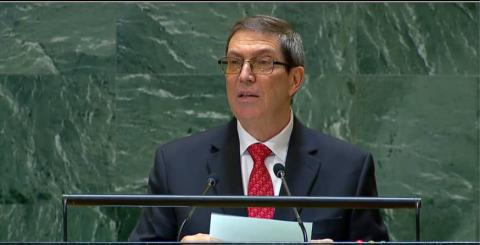
Bruno Rodríguez Parrilla, Cuba’s Foreign Affairs Minister, recently told the United Nations General Assembly that the United States is conducting “multi- dimensional, non-conventional warfare’’ against Cuba.
Warfare, he said, “that has already lasted for almost seven decades now and has become ever crueler and more ruthless during the last seven months’’.
Rodríguez was speaking on a motion before the UN titled, “Necessity of ending the economic, commercial and financial embargo imposed by the United States of America against Cuba”.
The motion passed with an overwhelming 136 UN member-nations voting to support it; only nine voted against it. Grenada joined Trinidad and Tobago as only two Caribbean nations to altogether abstain from voting on the motion.
Grenada’s abstention was shocking and surprising to DPM Leader and former Foreign Minister Peter David.
“I was absolutely surprised when I looked at the outcome of the voting. The vote was on whether or not the UN can have a debate on the sanctions. It wasn’t the issue of sanctions,’’ said David.
“Traditionally, Grenada has supported Cuba; traditionally, we have voted against sanctions; traditionally, we would have voted in support of a debate on the sanctions that are crippling Cuba,’’ he added, questioning whether Grenada is signalling a shift in its relation with Cuba.
Rodríguez, in his address to the UN, said “there is now an energy siege, which is equivalent to a naval blockade, which is an act of war. Cuba’s access to fuel supplies, both for commercial and humanitarian purposes, are being hindered by means of direct threats, unilateral coercive actions and even harassment or intimidation of oil tankers by US military naval assets’’.
In the past few months, he said the humanitarian damage to the Cuban population has intensified, with the infant mortality rate moving from 4.0 per one thousand live births to 9.9 per one thousand.
“This means that the death of 1780 newly born could have otherwise been prevented under different conditions and with the ideal equipment, devices and therapies,’’ Rodríguez said.
“The number of persons dying of cancer in the country has significantly increased. In the case of children and youths, the survival rate decreased from 85 per cent to 65 per cent. The trend coincides with the toughest moments of the US siege. The blockade asphyxiates and kills in a silent way. Paying attention to this ruthless crime is also a responsibility of the United Nations.’’
MP David and members of DPM have expressed their “strongest condemnation of the tightening of the economic, commercial, and financial blockade imposed by the government of the United States against the
Republic of Cuba, a policy that for more than six decades has undermined the daily life and development of the Island’’.
“We particularly denounce the energy siege resulting from the executive order signed by the White House on January 29, which seeks to paralyze Cuba’s electricity generation and worsen the living conditions of millions of citizens, ’’the DPM statement said “We likewise reject the other executive orders approved by the U.S. government during 2026, which reinforce unilateral coercive measures and constitute an act of political and economic aggression against a sovereign country. We also condemn the unfounded sanctions imposed on Cuban entities, which restrict their ability to trade, access financing, and participate in the international economy, directly affecting the population.’’
The statement from DPM also reads:
“At the same time, we recall that Cuba has been an example of international solidarity, sending doctors, teachers, and cooperation brigades to dozens of countries in need. From Africa to the Caribbean, the Greater Antilles has shared its human resources in times of health crises, natural disasters, and
reconstruction processes, in irrefutable demonstration of the values of the revolutionary project defended by that sister nation.
“Furthermore, we warn of the threat of military aggression looming from the United States, and caution that any attempt at intervention would be a flagrant violation of international law and regional peace.
“The Cuban people have demonstrated heroism and resilience in the face of these hostile policies, while maintaining their vocation for solidarity and cooperation with the peoples of the Caribbean.
“From the Democratic People’s Movement, we reaffirm our commitment to peace, justice, and solidarity in the Caribbean region and declare that the defense of Cuba is also the defense of the dignity and sovereignty of all Caribbean peoples. In the face of the tightening blockade, the energy siege, and the threats of aggression, our voice rises to proclaim that solidarity is not an option, but a historic duty.’’