
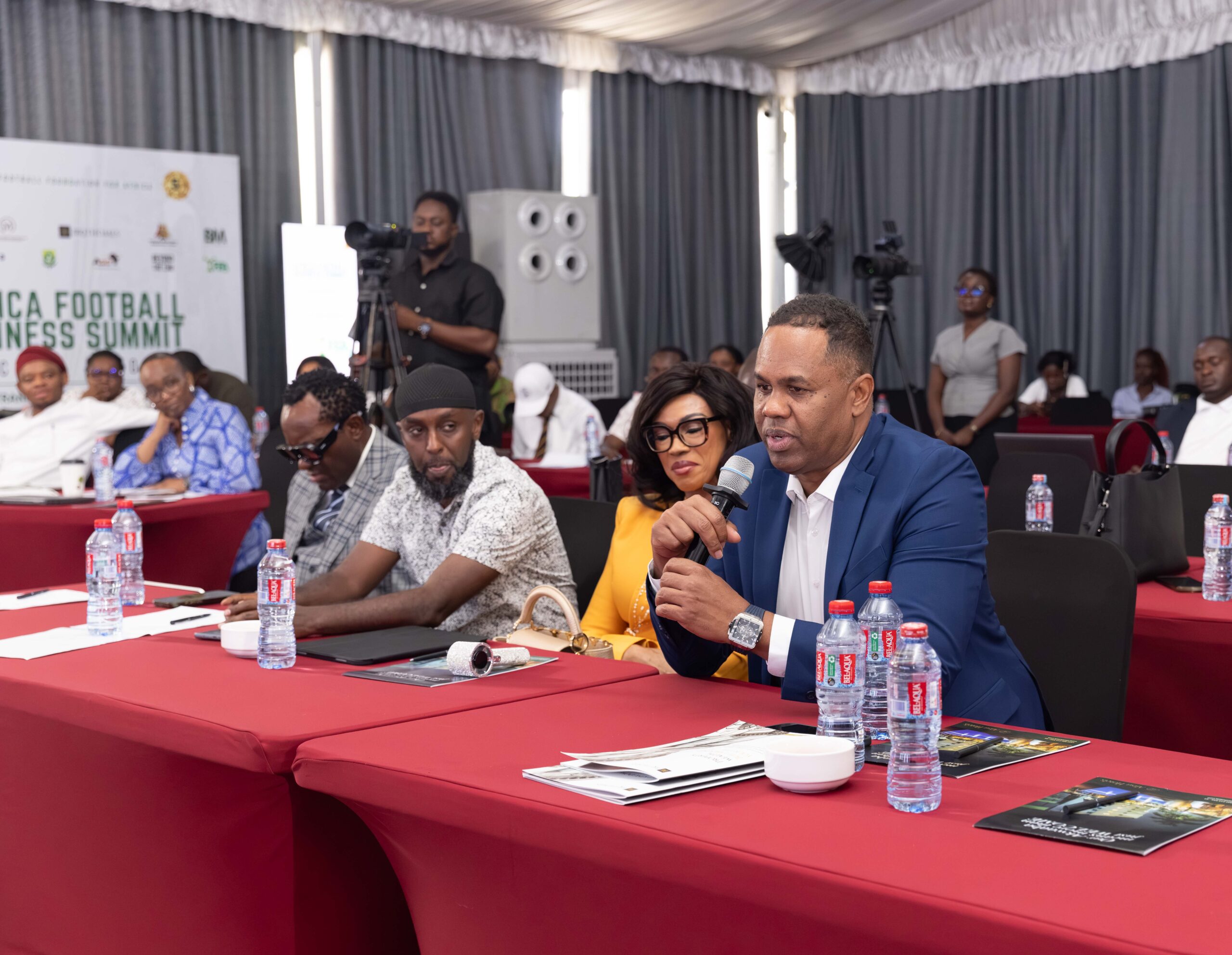
 President of the Grenada Football Association (GFA), Marlon Glean, has strengthened Grenada’s presence in international football dialogue following his participation in the 5th Africa Football Business Summit (AFBS 2026), where he contributed to high-level discussions on governance, financial accountability, institutional capacity and the sustainable development of football.
Held from October 22–23 at the Alisa Hotel in Accra, Ghana, AFBS 2026 brought together leaders from
football, business, government, academia, investment and development under the theme “From Vision to
Value: Building a Sustainable Football Economy for Africa.”
Glean participated in the programme session “Transparent Institutions & Accountable Football Finance,”
under the strategic theme Governance, Integrity & Institutional Capacity, bringing the perspective of Grenada and a small developing football association to discussions around some of the most important institutional challenges facing the global game.
The session examined how independent auditing, financial transparency, policy development, institutional
capacity and stronger governance can make football organisations more accountable, sustainable and attractive to investment.
Reflecting on his participation, Glean said good governance must ultimately be understood in terms of the
development it enables. “Good governance is not separate from football development. It is what protects
development and gives governments, sponsors, development partners and investors confidence that their
investment can produce lasting results,” he said.
“It is possible to finance a project without building an institution. Our responsibility is to ensure that we are
also developing the people, systems, controls and institutional capacity required to sustain that investment
long after the initial project has been delivered,” Glean continued.
Glean’s contribution drew on his combined experience as President of the GFA, an Attorney-at-Law, former
FIFA Regional Office Development Manager for the Caribbean and international football administrator.
A central theme of his contribution was the need for developing football nations to invest not only in players, coaches, referees and facilities, but also in the administrative structures that allow the game to function professionally and sustainably.
This includes stronger financial management, competition administration, commercial development,
communications, safeguarding, project management, governance and long-term institutional planning.
“Capital does not only look for opportunity; it looks for confidence,” Glean noted. “If we want to attract
greater and more sustainable investment into football, our institutions must give partners confidence in how decisions are made, how resources are managed and how outcomes are measured.”
The discussion closely aligns with the GFA’s continued efforts to strengthen the structures underpinning
football development in Grenada, including grassroots and schools football, coaching and referee education, infrastructure, club development, commercial partnerships, player pathways and increased opportunities for young footballers.
For Glean, one of the critical lessons for developing football nations is that sustainable progress requires
institutions capable of protecting and multiplying the value of investment over time.
That means building systems that can withstand changes in leadership, preserve institutional knowledge,
maintain financial discipline and ensure that development programmes continue to serve the needs of players, clubs, communities and future generations.
While the scale and circumstances of African and Caribbean football differ, Glean highlighted several
institutional questions shared by developing football nations, particularly around infrastructure limitations,
access to sustainable investment, professional administration, talent development and the challenge of
retaining more of the economic value generated by football.
His participation also contributed to a wider conversation around how stronger links between Africa and the Caribbean could support the exchange of knowledge, institutional expertise, talent-development opportunities and new areas of football cooperation.
The Summit’s broader discussions reflected an important shift in the development conversation for emerging football regions, from representation alone towards building the institutional strength required to create, retain and benefit from the value football generates.
That perspective is particularly relevant to Glean’s wider outlook for Caribbean football: that smaller nations
should participate confidently in international football dialogue while continuing to strengthen the institutions, pathways and partnerships required to create sustainable opportunities at home.
His appearance at AFBS 2026 follows a growing series of international engagements through which the GFA
President has advocated for greater development opportunities, stronger institutions, improved international partnerships and more meaningful participation for smaller football nations in shaping the future of the game.
For the GFA, participation in forums such as AFBS provides an opportunity not only to contribute Grenada’s
perspective, but also to engage with ideas, experiences and potential partnerships that can support the
continued development of football locally.
“Our goal should not simply be to participate in the football economy,” Glean said. “We must continue
building institutions capable of shaping it and ensuring that more of the value football creates ultimately
returns to our players, our communities and the generations coming behind us.”


